
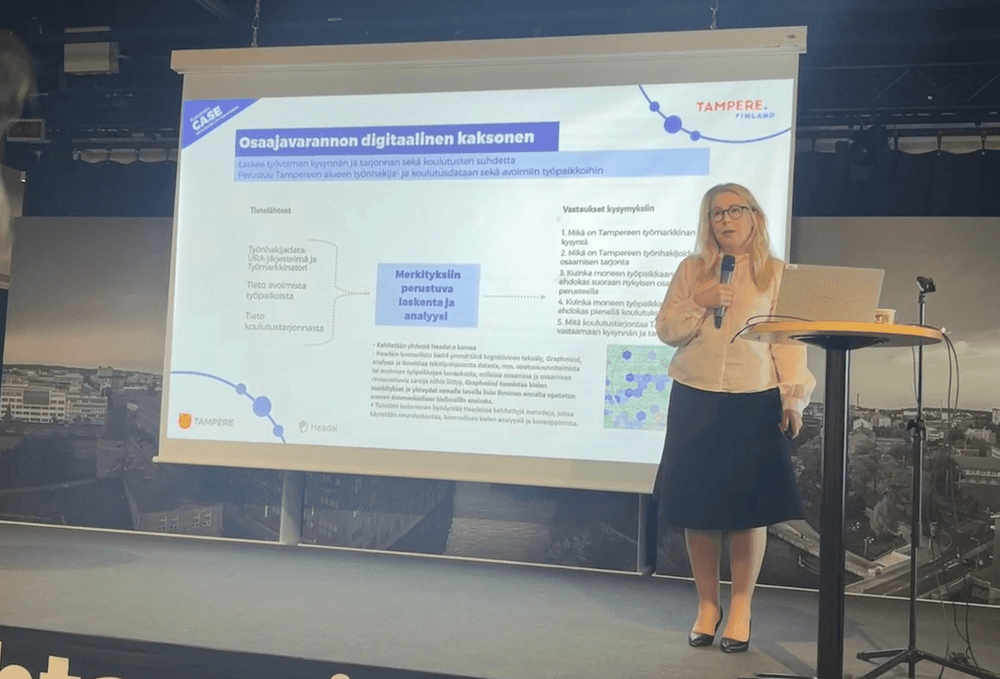
Cities worldwide aim to solve the challenges that create thriving cities in all aspects, including concerning work and labour markets. Identifying and closing the gap between skills demand and the existing talent pool is the number one challenge in the labour market. It is crucial for organisations looking for talent, for whom each open job equals an average of 100,000 € in revenue losses in Finland in a year, for the individuals looking for employment for financial safety as well as personal and professional growth, but also for the public sector as each unemployed person results in approximately 22,000 € in unemployment costs every year.
Filling open positions is, therefore, a joint effort between public and private actors to generate revenue as well as decrease unemployment costs. For this ecosystem to function properly, organisations looking for talent and job seekers require the support of educational institutions that provide training relevant to the market, the people and the public administration.
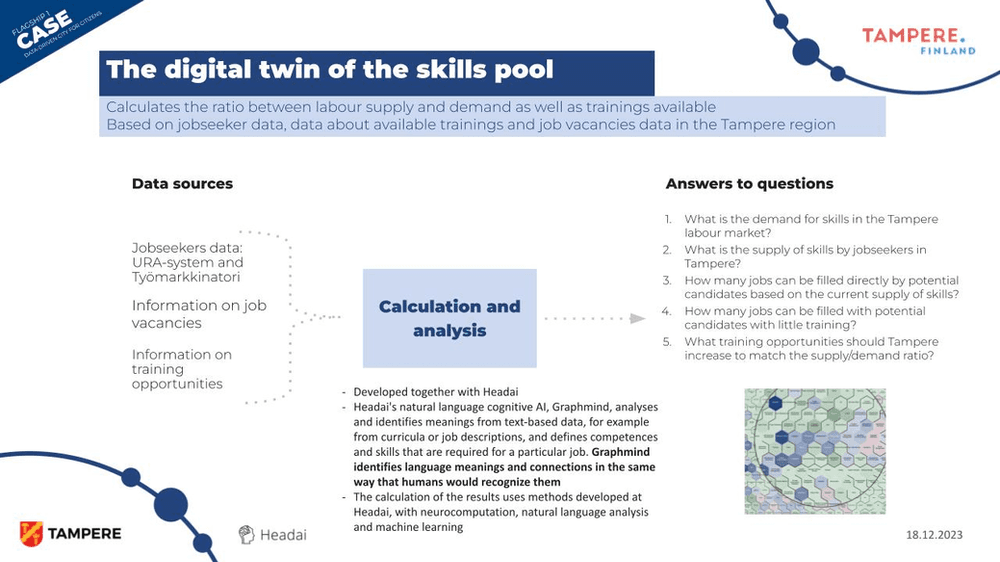
Headai has partnered with the city of Tampere and Its Employment and Growth Services to do this, creating a novel approach to the meaning of a smart city in the context of skills and employment. By using digital twin technology and AI-based data analytics solution, Headai created a complete Tampere skills inventory with real, anonymised data from official sources using Headai’s technology, compared to over 9,000 job ads for a full picture of how many jobs can be filled immediately, how much training is needed and what new training is needed to make the Tampere ecosystem work optimally.
Matching the profiles with a selected industry’s job openings allowed us to identify direct candidates for roles, candidates that could easily upskill to match the roles, as well as the roles that could not be filled based on existing profiles to then create recommendations on closing the gap between job seekers and providers. Such an exercise is beneficial for all parties involved as it creates a realistic, real-time overview of the job market without categorising and labelling real-life job seekers. The experiment demonstrated an immediate increase of 3 000 000 € in GDP, as well as an increase of up to 20 000 000 € in revenue for companies after including training adjustment by education providers to fill gaps.
Irene Impiö, Director of Growth Services at City of Tampere emphases the value of this experiment in developing the city’s strategy to bridge the gap between skills demand and talent.
The experiment was direct proof of the efficiency of conducting analysis not only from the perspective of one actor in the labour market at a time but across the whole ecosystem, with the lead of the city administration and in collaboration between public and private actors.
The unique experiment demonstrated the feasibility and potential positive impact of such mapping on employment by involving the city stronger than before in the ecosystem using the newest technological opportunities.

Petri Pekkola, a labour market specialist in the City of Tampere, emphasises the value of this experiment in developing the city’s strategy to bridge the gap between skills demand and talent:
”Our goal is to find out the skills pool of our region in an agile way and that is why we want to pilot Ai in this field. We will use this information extensively to ensure skilled labour availability in the region and anticipate changing training needs in local companies.”
Smart cities are constantly searching for new and innovative ways to ensure their economically, ecologically and socially sustainable development. In the words of Harri Ketamo, CEO at Headai, “Economy feeds economy” and filling the gap between skills demand and talent contributes to economic growth on a tremendous scale. Filling the skills gap is often only looked at from the perspective of reducing unemployment, in this way overlooking the vast effect it has on the economy as a whole. Today’s technology is disrupting the labour market, but it is at the same time providing never-before-seen opportunities for growth if we are daring enough to grasp them. With its skills inventory based on AI and data analysis, the City of Tampere is on it. Are you?

Helping YTK members find work that matches their real skills

Turning fragmented skills data into shared decisions with LEADSx2030

Seeing what's actually happening in an industry, before it shows up in official statistics
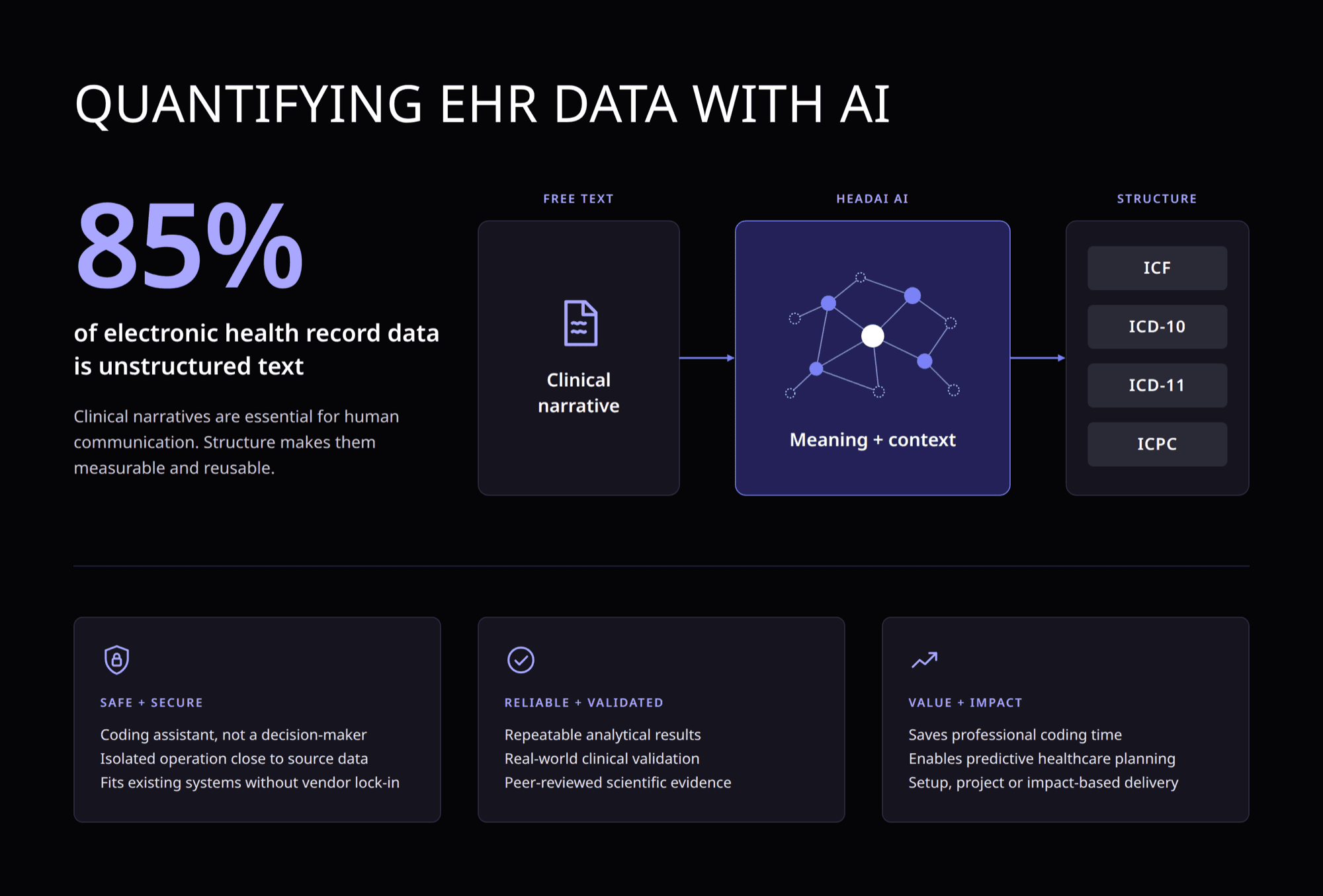
Turning clinical notes into explainable ICF and ICD codes

Consistent where generative AI is not: keywording 5,585 project applications