

Educational institutions constitute the backbone of our society by preparing people for the labour market. Their role in providing adequate training for the current needs of the labour market is essential, as well as their greatest challenge. In practice, maintaining the connection between education and the labour market requires constant active efforts from both parties to understand each other’s needs and the gaps between them and bridge those. A quick-paced labour market in near-constant disruption is making this task even more challenging for education experts building curricula. While staying up to date with the current situation, it is increasingly important to also be able to project into the future to stay one step ahead and be able to cater for the needs of tomorrow. For this reason, educational institutions have a growing interest in data-driven solutions for supporting curriculum development in an agile and flexible manner that takes into account the specific needs of the industry and the area, and not only gives an overview of the fit between curricula and the labour market in the past and the present but also predict future trends.
The Importance of Locality in curriculum development
While staying up to date with the labour market needs is a global challenge for educational institutions and decision-makers worldwide, the solutions require a focus on locality. Data-driven solutions give access to large datasets virtually from anywhere in the world, but relevant results can only be reached by narrowing the data down to not only the specific field that the education is preparing learners for but also the geographical location. Culture, political decision-making, and the industry’s role focus, and development in the society in question affect the specific skills needed in the market and have to be taken into account in the sample size and scale for accurate results.
Skills data as a tool for agile curriculum development
Defining this sample followed by finding, combining and analysing not only local but also industry-specific data is a challenge for both educational institutions and businesses looking for talent. Skills data provides a tool that makes large datasets interoperable and allows predictive results for future developments using AI-based technology while taking into account the need to limit datasets according to different factors such as location or industry. Skills maps can then be created both for the needs of the labour market and for the skills developed by curricula, after which the two can be analysed jointly to identify gaps and drive education offering closer to the labour market.
Headai’s case studies: from Finnish secondary technical education to higher education in the Philippines
Headai has been working with a number of educational institutions in Finland and abroad to map the current status of their curricula against labour market needs, bridge gaps between the two and forecast future developments. Most recently, Headai has been working in collaboration with the National Board of Education of Finland and educators as well as Technology Industries of Finland to map current needs and offering in the field of technical secondary education in Finland. The project resulted in a soon-to-be-published action plan to develop curricula to fit the needs of the industry better.
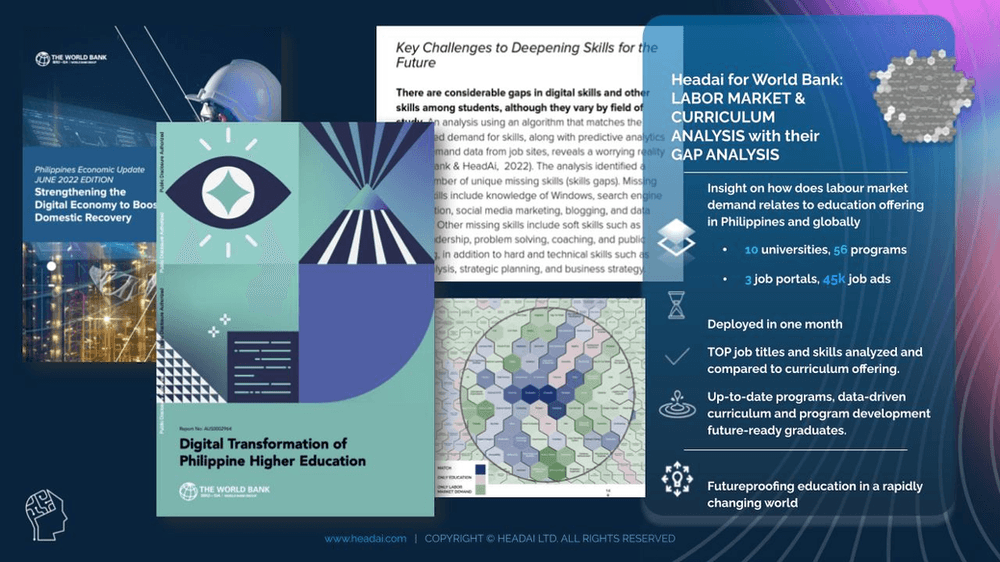
In addition to local projects in Finland, Headai has been at the forefront of data-driven curriculum development using skills data also internationally. In 2022, a project with the World Bank in the Philippines mapped the current state of higher education in the country, resulting in a number of recommendations to create more timely adapted curricula that can still be individually tailored by educators according to their expertise, interests, and students, while being better aligned with the local industry needs.
Local solutions for global challenges
Such projects have proven that the challenges faced in creating and improving curricula are global and shared by educators across the world no matter the degree of education, geographical scale, or industry-specificity. However, there is no one universal solution to these challenges, and each case has to be considered individually according to the data specific to it. Skills data provides tools and approaches adaptable to the specific context through methods tested across the world with different datasets. Solutions such as Headai’s help educators across the globe shape curricula to fit not only today’s job market needs but also the ones of tomorrow. To get you started today, we at Headai have developed a platform that provides access to a mapping tool and a large existing repository of skills maps based on our widely tested AI-driven technology, usable for benchmarking your curricula with the current state of the job market. At the same time, the platform also allows you to input your own data to visualise the current state of the skills match between education offerings and the labour market in your specific institution, industry or area. Take a look at the current maps offered, and contact us for more information on your specific needs.
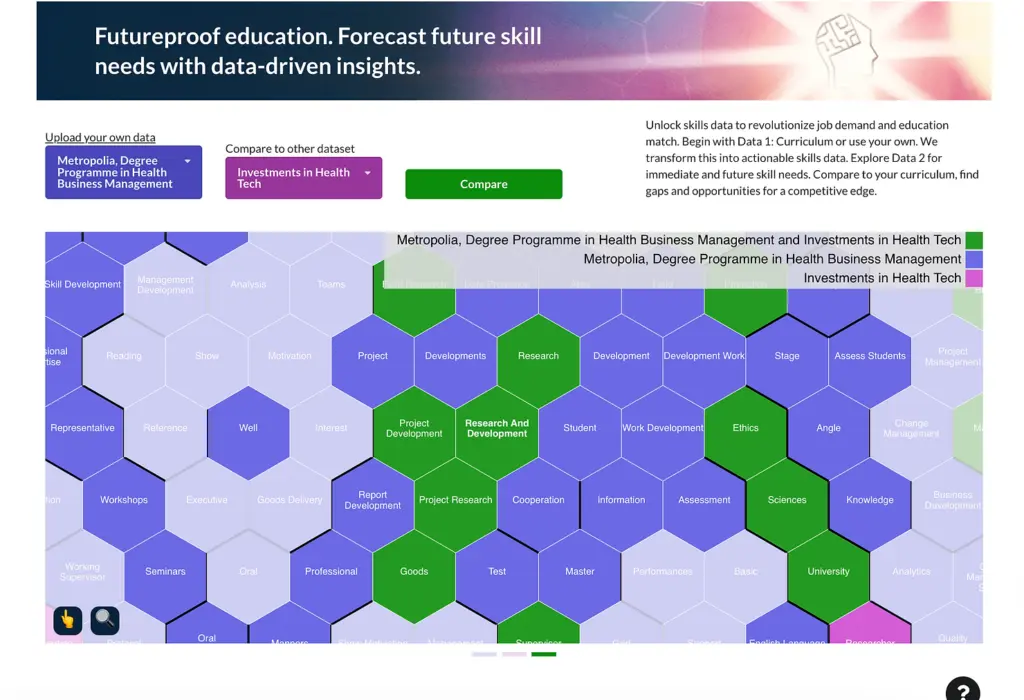
Our platform is currently open in beta version for a 14 days free trial using our existing datasets.
To sum up – our top 3 ways educational institutions are leveraging skills data:
Narrowing data sample down to the specific location and sector for the most accurate results
Analysing skills supply by educational institutions and demand by the labour market over time to spot trends and make predictions to be one step ahead
Comparing current education offerings with skills needs in the labour market on a local, national or international level using tools such as Headai’s platform

Helping YTK members find work that matches their real skills

Turning fragmented skills data into shared decisions with LEADSx2030

Seeing what's actually happening in an industry, before it shows up in official statistics
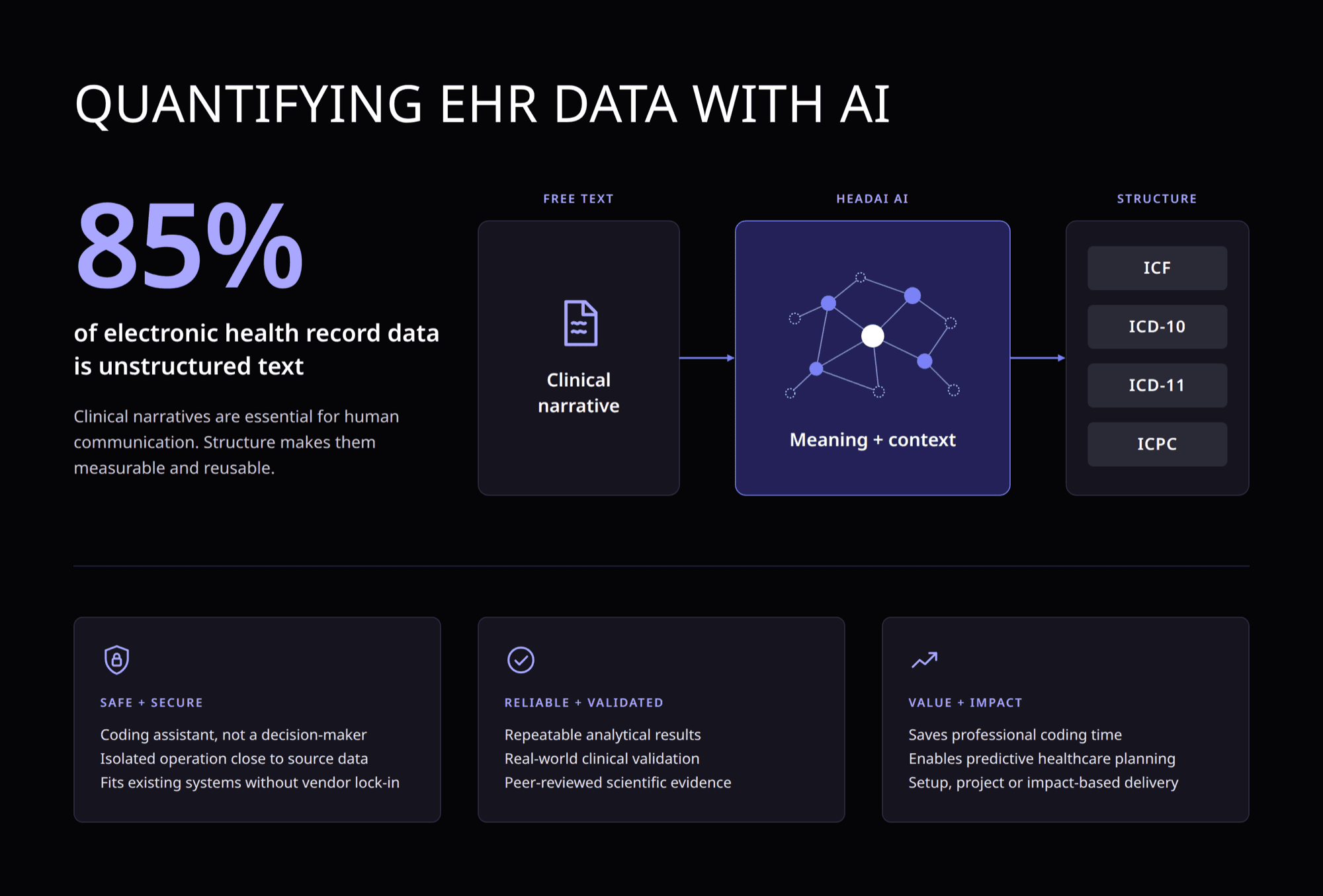
Turning clinical notes into explainable ICF and ICD codes

Consistent where generative AI is not: keywording 5,585 project applications