
On the 9th of June, MD Linda Nieminen successfully defended her doctoral dissertation at Tampere University on the topic of “Decision support for tailored biopsychosocial rehabilitation in non-specific low back pain”. MD Nieminen leveraged Headai’s innovative AI platform in her research to identify individual factors crucial in guiding rehabilitation for patients suffering from chronic back pain. This significant milestone highlights the transformative impact of using AI technology in improving treatment outcomes for patients.
Väitös: Tekoäly auttaa tunnistamaan yksilölliset kuntoutusta ohjaavat tekijät selkäkipupotilailla
Transforming rehabilitation for back pain patients
MD Nieminen’s research, conducted under the supervision of Headai’s co-founder Harri Ketamo, sheds light on the profound influence of individual characteristics, such as age, gender, psychological well-being, and socio-economic background, on the rehabilitation journey of back pain patients. By harnessing the power of Headai’s advanced machine learning algorithms to aggregate and analyse extensive patient data, she uncovers invaluable new insights into the factors that contribute to successful rehabilitation.
“Human-centred technology makes it possible to increase productivity so that more time is left for the meeting between the doctor and the patient. However, this requires high-level research, which is why works like Linda Nieminen’s dissertation are necessary trendsetters.” – Harri Ketamo
As MD Nieminen’s doctoral thesis supervisor, Ketamo emphasises the importance of human-centred technology in healthcare. He states, “Human-centred technology makes it possible to increase productivity so that more time is left for the meeting between the doctor and the patient. However, this requires high-level research, which is why works like Linda Nieminen’s dissertation are necessary trendsetters.”
Pioneering predictive capabilities of AI in healthcare
One of the most remarkable achievements resulting from MD Nieminen’s research is the development of an AI system capable of predicting the effectiveness of various rehabilitation approaches based on individual characteristics. This groundbreaking predictive capability aids healthcare professionals to make informed decisions and tailor treatment plans to suit each patient’s unique needs, ultimately leading to enhanced outcomes. For us at Headai, it is also a source of pride and excitement to see a new application of our technology in the field of healthcare.
The success of MD Nieminen’s doctoral dissertation, supported by Headai’s cognitive computing infrastructure, represents a significant leap in personalised medicine. By combining AI technology with clinical knowledge, healthcare professionals can provide more precise diagnoses, personalised interventions, and improved patient care, revolutionising the healthcare landscape. The ongoing research at TAYS Central Hospital signifies a promising future for personalised medicine, transforming the lives of individuals suffering from chronic back pain.
As Headai continues to spearhead innovation and collaborate with esteemed experts, the future of AI in healthcare holds tremendous promise. Headai remains dedicated to advancing medical research, transforming the healthcare industry, and positively impacting countless lives through the power of AI.

Helping YTK members find work that matches their real skills

Turning fragmented skills data into shared decisions with LEADSx2030

Seeing what's actually happening in an industry, before it shows up in official statistics
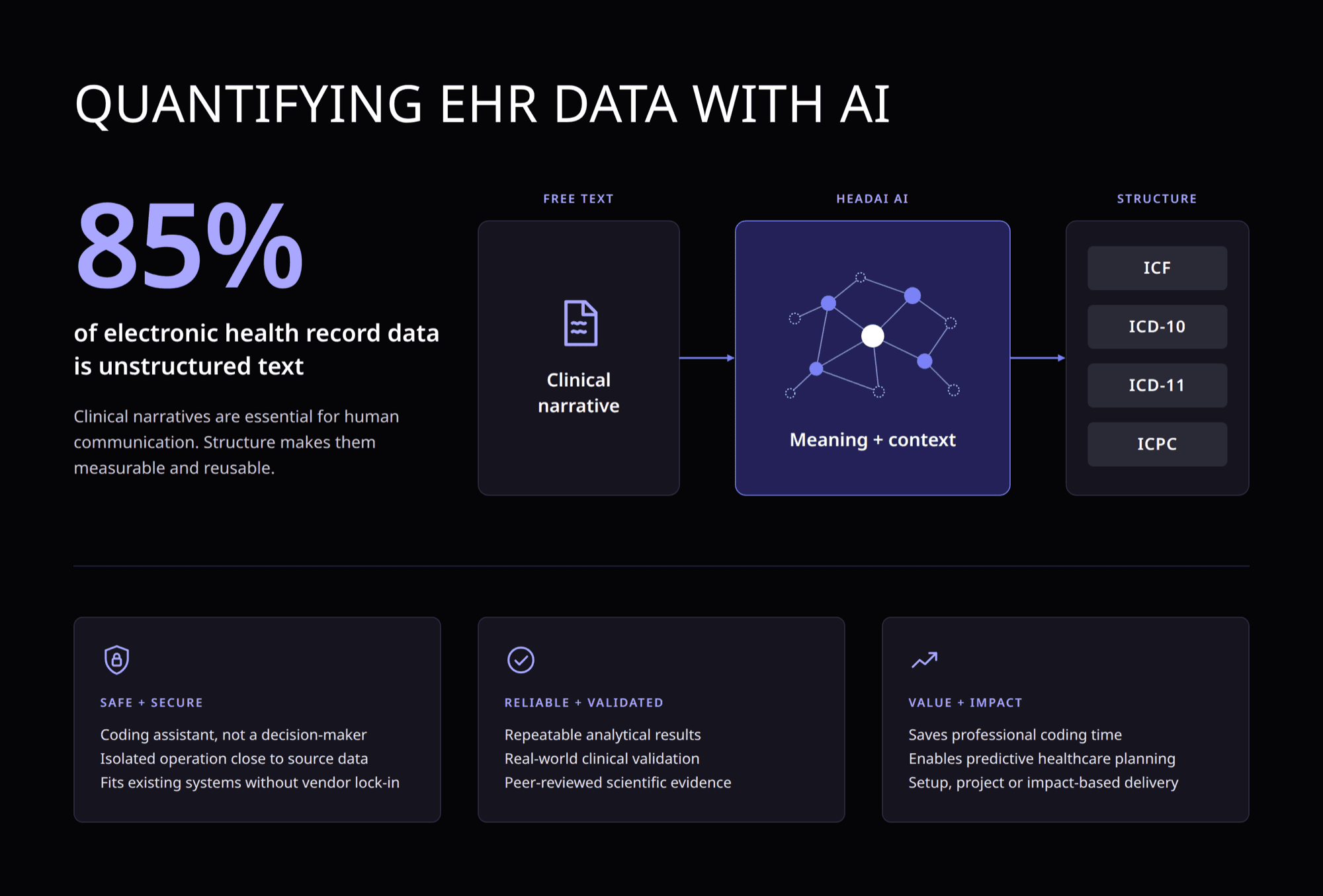
Turning clinical notes into explainable ICF and ICD codes

Consistent where generative AI is not: keywording 5,585 project applications