
The definition of Digital Twin technology is the process of using data streams to create a digital representation of a real-world asset to improve collaboration, information access, and decision-making. A digital twin can be used to manage, change and share information related to its physical counterpart. Traditionally digital twins are used to collect and process data to develop a product or service.
“Digital Twin is a relatively old concept”, explains Harri Ketamo, the Founder and Chairman of Headai, a Finnish company that delivers technology to make data interoperable between individuals, companies, education, and labour markets.
“Originally Digital Twins meant simulation components for example in an industrial environment. For example, a digital twin could be an accurate virtual model for machine maintenance and product development that reports on its activities based on collected data. A digital twin could be used to manage, change and share information related to its physical counterpart.”
The right Digital Twin technology could influence every part of our world
The next step in the evolution of digital twins was to adopt the idea, that a digital twin was not seen as merely one big simulation of its components, but a digital twin is a component.
For example, an airport could have several different digital twins; one for an airplane, a digital twin for luggage logistics, one for personnel, etc., and with the help of digital twins they could simulate improvements and changes to the whole processes by altering one or several digital twins.
Further on, digital twin technology advanced into more abstract fields eg. digital twin of people skills, my skills, labour market, educational systems, market needs, and so on.
“We can start to simulate economy as a bigger system when we have enough digital twins – enough components that we can make work together and simulate against each other as a system”, Harri Ketamo explains. In the age of digital transformation, the right twin technology could influence every part of our world.
The making of modern Digital Twins
“We at Headai have generated mechanisms that enable us to turn relevant texts into digital twins,” says Ketamo.
“My digital twin can be based on my blog posts, and the activities I have done during my life; gaming, sports, etc. The labour market digital twin can be based on job ads. It is equally important to understand what the companies are doing. So the digital twin of a company could be based on its product materials, marketing materials, statistics, etc. A Digital twin for the market demand could be based on economic news, trends forecasted by experts, local and global politics, etc.
We just need to be creative for defining a data set from which we can teach the digital twins”, he concludes.
Digital twins are basic components that we can use to run smaller or even ecosystem-level simulations
In Headai processes, when we find a relevant data set, we can apply our existing focus language model to turn the text into a digital twin. And because they are our digital twins, our normalized knowledge crafts, we can immediately start to simulate a digital twin against the other digital twins, for example, my skills compared to labour market needs.
“The beauty of digital twins is, that they are just data components, but when we can make them work together we can start to run different simulations. We can reuse the digital twins and even simulate them continuously. Digital twins are basic components that we can use to run smaller or even ecosystem-level simulations. That is the significance of the digital twins.”
The most difficult thing is to build a normalized digital twin, that can be compared to and can be simulated against other digital twins. It is essential to make sure they are not isolated data sets. And that is what we are doing at the Headai, explains Ketamo.
When we can simulate different digital twins that are not isolated but can run against other digital twins, the economic benefits are huge, -Only in labour market activities, if a company is short of one person, the revenue losses are from 100 000 € to infinity. Let’s take the lowest loss expectation 100 000 euros and see that there are 40 000 open jobs in Finland. With a quick calculation, the losses to Finnish *GDP are 4000 million euros every month.
If we can simulate this and make only a 10 % improvement the benefit would be 400 million euros per month added with reduced unemployment costs etc. The even bigger monetary loss compared to the unemployment costs to the country are the profit losses for the companies. The demand for digital twins is accelerating at an incredible rate. Digital twins are increasingly advancing as companies, cities and countries seek new ways to leverage data eg. in the business ecosystems, Harri Ketamo concludes.
*Gross domestic product (GDP) measures the monetary value of goods and services produced within a country’s borders in a given period, usually a quarter or a year.

Helping YTK members find work that matches their real skills

Turning fragmented skills data into shared decisions with LEADSx2030

Seeing what's actually happening in an industry, before it shows up in official statistics
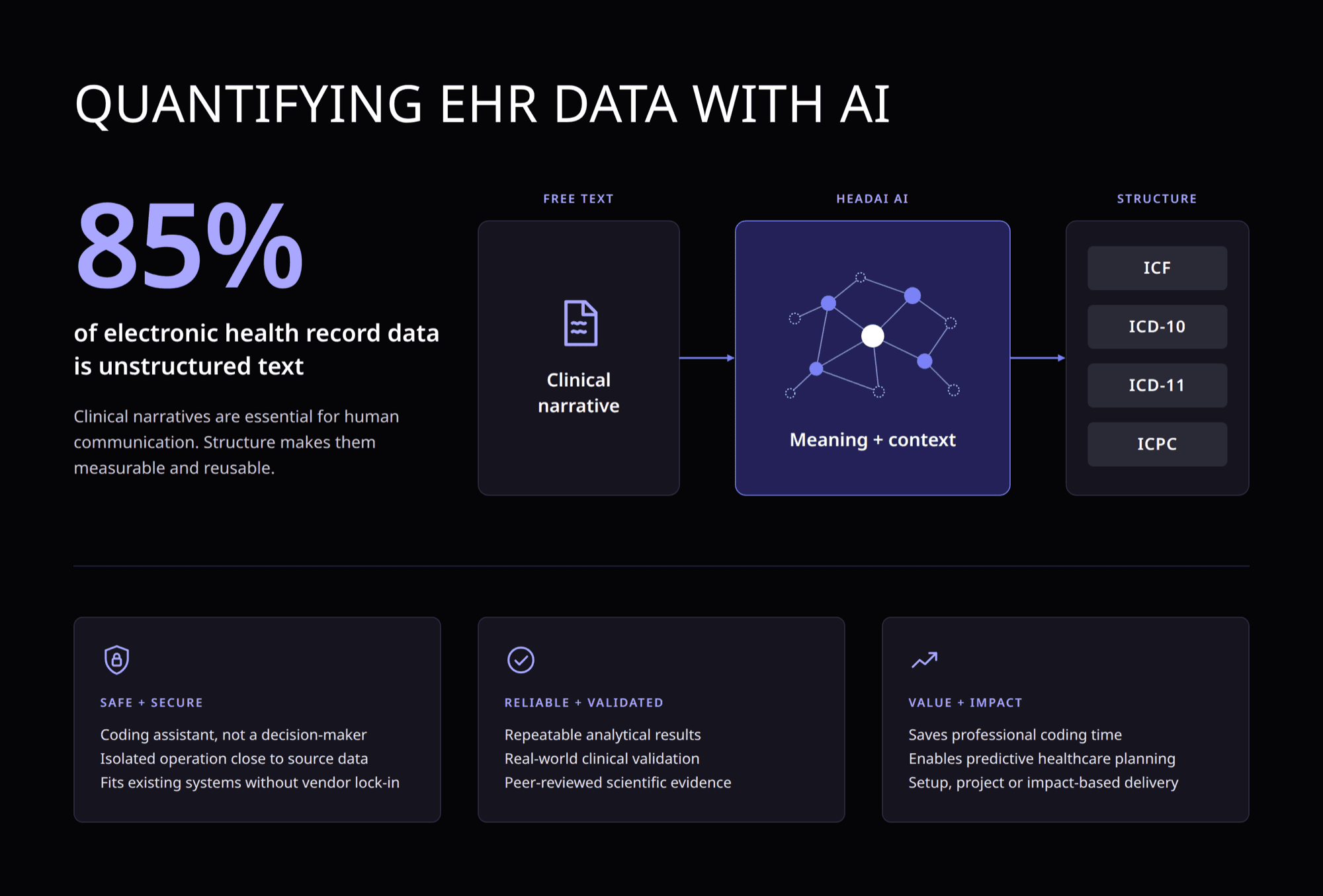
Turning clinical notes into explainable ICF and ICD codes

Consistent where generative AI is not: keywording 5,585 project applications