Seeing what's actually happening in an industry, before it shows up in official statistics

Seeing what's actually happening in an industry, before it shows up in official statistics

Official statistics show what already happened. Headai's Growth Agents track 20 technology areas in real time, using one unified data language so frontier AI can analyze industry signals without hallucinating, and trace every insight back to its source.

Official statistics show what already happened. Headai's Growth Agents track 20 technology areas in real time, using one unified data language so frontier AI can analyze industry signals without hallucinating, and trace every insight back to its source.

Technology areas tracked in real time

Technology areas tracked in real time

20

20

Data types in one normalized skills language

Data types in one normalized skills language

4

4

The Challenge

Official statistics tell you what already happened, months or years after the fact. Business Finland needed a way to see technology-sector activity as it's forming: what industry voices are actually saying right now, what leading companies are doing differently, where R&D is shifting, and where investment is moving, across dozens of fast-moving technology areas, using signals that never make it into traditional reporting.

The Solution

Headai built a set of technology-area agents ("Growth Agents"), each covering one of 20 technology categories and drawing on terabytes of raw data from news, research publications, investment activity, and job postings. Each agent tracks four things continuously: what industry influencers are saying and how the conversation is shifting, what leading companies are doing and how their behavior is changing over time, where R&D trends and early signals are emerging, and where investment levels stand and which direction they're moving.

What makes this different from a standard dashboard is the semantic layer underneath it. Instead of four disconnected views with mismatched vocabularies, all four data types (news, research, investment, jobs) are converted into one normalized skills language, at the same level of granularity. That consistency is also what lets the agents run on frontier LLMs without hallucination: because the underlying data speaks one language, the models aren't forced to reconcile clashing terms or drown in oversized context.

The Promise

The result is insight grounded in real-world activity, not lagging statistics, and every insight is traceable back to its original source. Users don't have to take the analysis on faith or wonder where a claim came from; they can follow it back to the actual document, listing, or publication behind it.

Build curricula for what comes next

Build curricula for what comes next

Use skills data to understand changing labour-market needs and keep education aligned with the skills that matter.

Use skills data to understand changing labour-market needs and keep education aligned with the skills that matter.

Understand local skills demand

Understand local skills demand

Identify emerging skills gaps

Identify emerging skills gaps

Compare education with labour-market needs

Compare education with labour-market needs

Track how skills needs change over time

Track how skills needs change over time

Helping YTK members find work that matches their real skills

Job seekers couldn’t see which of their skills mattered, or which jobs actually fit. Headai built a skills-based recommendation engine, now live in production with 1,500+ monthly users and growing.

Job seekers couldn’t see which of their skills mattered, or which jobs actually fit. Headai built a skills-based recommendation engine, now live in production with 1,500+ monthly users and growing.

Turning fragmented skills data into shared decisions with LEADSx2030

Europe’s skills demand, education provision and technology signals were fragmented. LEADSx2030 now connects the evidence in one public Observatory, helping users compare demand and supply and identify where to act.

Europe’s skills demand, education provision and technology signals were fragmented. LEADSx2030 now connects the evidence in one public Observatory, helping users compare demand and supply and identify where to act.

Seeing what's actually happening in an industry, before it shows up in official statistics
Official statistics show what already happened. Headai's Growth Agents track 20 technology areas in real time, using one unified data language so frontier AI can analyze industry signals without hallucinating, and trace every insight back to its source.

Official statistics show what already happened. Headai's Growth Agents track 20 technology areas in real time, using one unified data language so frontier AI can analyze industry signals without hallucinating, and trace every insight back to its source.

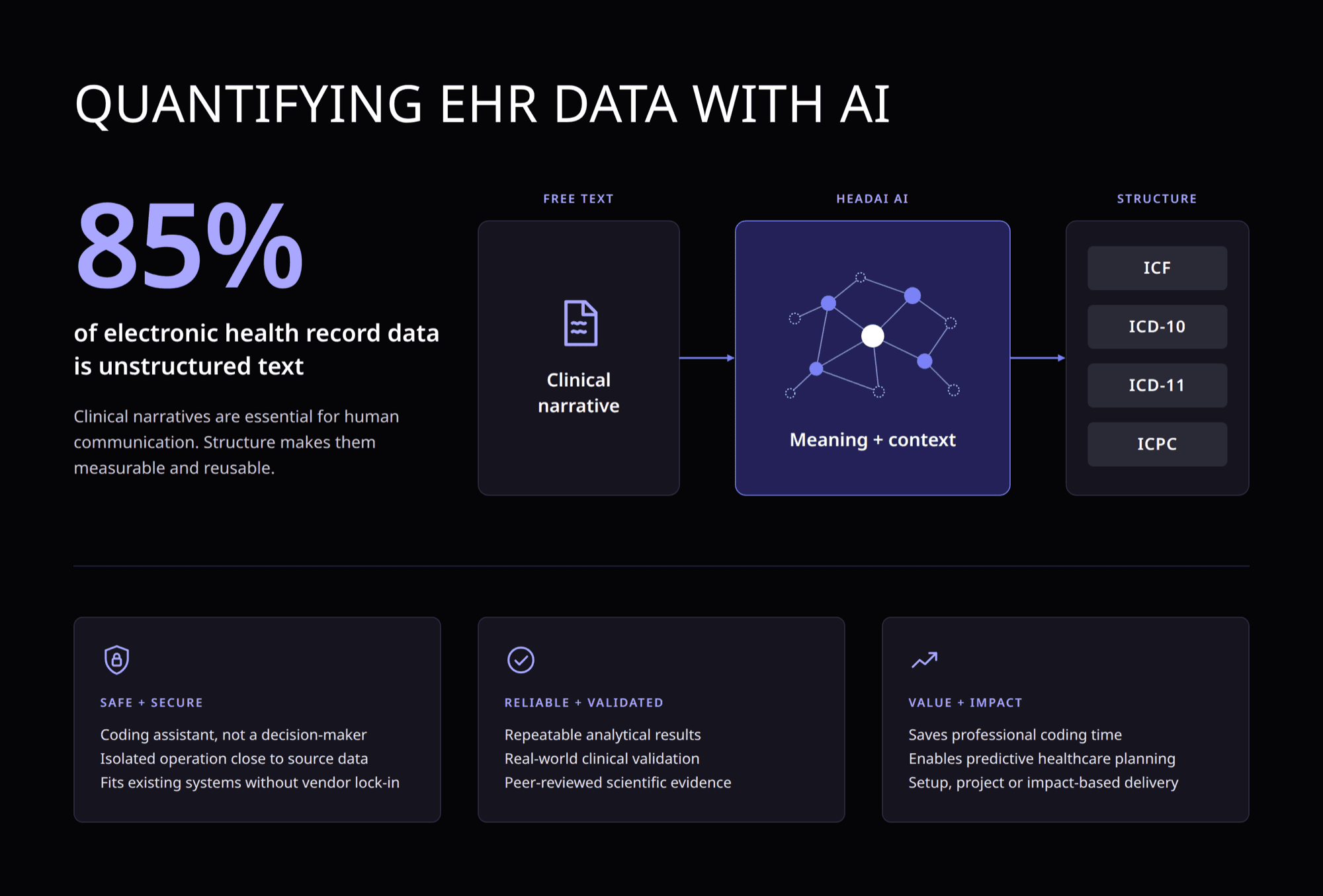
Turning clinical notes into explainable ICF and ICD codes

Most patient record data is free text, hard to compare or analyse at scale. Headai's Health Coder turns clinical notes into ICF and ICD codes, each traced to the passage it came from. Validated in two peer-reviewed studies in 2025.

Most patient record data is free text, hard to compare or analyse at scale. Headai's Health Coder turns clinical notes into ICF and ICD codes, each traced to the passage it came from. Validated in two peer-reviewed studies in 2025.

Consistent where generative AI is not: keywording 5,585 project applications

Rural development applications were keyworded by hand, unevenly. Headai structured 5,585 applications against an 84-term ontology, raising the average from 3.9 to 4.9 keywords per application and suggesting useful new themes for 99.5% of them.

Rural development applications were keyworded by hand, unevenly. Headai structured 5,585 applications against an 84-term ontology, raising the average from 3.9 to 4.9 keywords per application and suggesting useful new themes for 99.5% of them.

Ready to turn information

into intelligence?

Ask questions across your organisation’s information without query languages or specialist tools.

Ready to turn information

into intelligence?

Ask questions across your organisation’s information without query languages or specialist tools.

Ready to turn information

into intelligence?

Ask questions across your organisation’s information without query languages or specialist tools.