Turning clinical notes into explainable ICF and ICD codes

Turning clinical notes into explainable ICF and ICD codes

Most patient record data is free text, hard to compare or analyse at scale. Headai's Health Coder turns clinical notes into ICF and ICD codes, each traced to the passage it came from. Validated in two peer-reviewed studies in 2025.

Most patient record data is free text, hard to compare or analyse at scale. Headai's Health Coder turns clinical notes into ICF and ICD codes, each traced to the passage it came from. Validated in two peer-reviewed studies in 2025.

Peer-reviewed validation studies in 2025

Peer-reviewed validation studies in 2025

2

2

Standard classifications returned

Standard classifications returned

ICF · ICD · ICPC · MeSH

ICF · ICD · ICPC · MeSH

The challenge

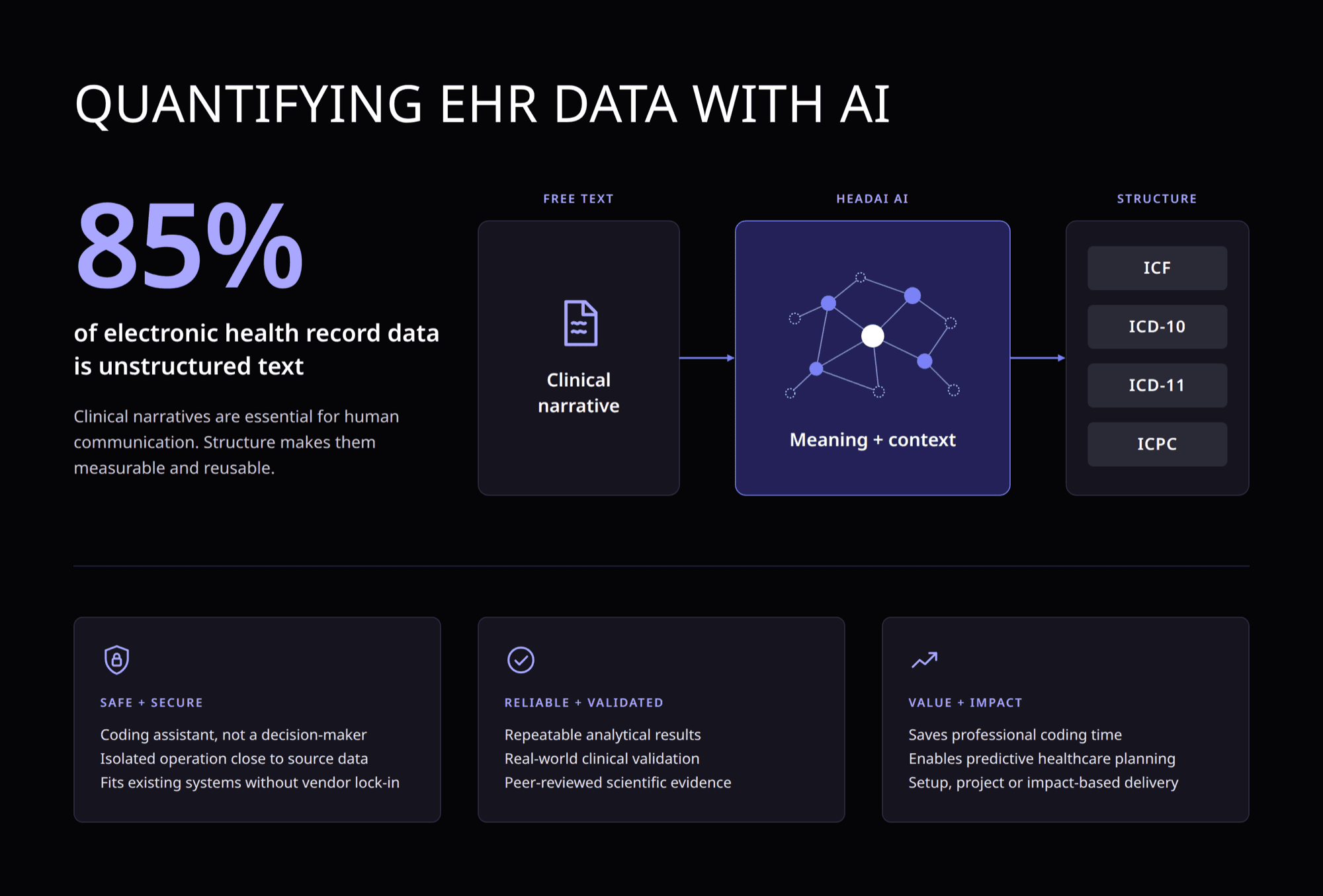
Most of the information in electronic health records is free text written by doctors and nurses. It works well for communication between professionals, but it is hard to compare, aggregate and analyse reliably across large volumes of records. Pirha needed a way to turn clinical notes into structured functioning and diagnosis data, supporting professionals' work rather than replacing their clinical judgement.

What Headai built

Headai Health Koodittaja is a clinical coding assistant that reads the text a doctor or nurse has written, identifies its meaning and returns standardised codes such as ICF, ICD-10, ICD-11, ICPC and MeSH. It uses self-supervised and graph-based machine learning built on Headai's semantic knowledge graph.

The solution works directly with the customer's own data: it runs as an isolated component next to the source data inside the secure EHR environment, integrates with existing systems without vendor lock-in, and returns every code together with a quality indicator and the passage of text it is based on. Headai acted as Pirha's technology and science partner, combining healthcare practice, functioning classifications and AI research.

Questions it answers

  • What does this patient record say about the person's functioning, in ICF terms?

  • Which diagnosis codes does the clinical text support?

  • Why was this code suggested, and which part of the text is it based on?

  • How can free-text records be compared and aggregated across large datasets?

  • How can changes in functioning be followed over time?

Quantifying EHR data with AI

Impact

Structured data makes patient records comparable and opens new possibilities for knowledge-based management, research, service planning and monitoring changes in functioning. For every text, the solution produces a structured, explainable list of codes to support the professional's work.

The scientific and clinical validation carried out at Pirha was published in two peer-reviewed studies in 2025: one validating a self-supervised architecture for automated ICF coding in electronic health records, and one applying graph machine learning to identify functioning in patients with low back pain. The collaboration continues.

Explore the story

Pirha: Functioning classification can be mined from patient texts

Discover Artificial Intelligence (2025): Validation of a self-supervised architecture for automated ICF coding in EHRs

Scientific Reports (2025): Using graph machine learning to identify functioning in patients with low back pain in terms of ICF

Build curricula for what comes next

Build curricula for what comes next

Use skills data to understand changing labour-market needs and keep education aligned with the skills that matter.

Use skills data to understand changing labour-market needs and keep education aligned with the skills that matter.

Understand local skills demand

Understand local skills demand

Identify emerging skills gaps

Identify emerging skills gaps

Compare education with labour-market needs

Compare education with labour-market needs

Track how skills needs change over time

Track how skills needs change over time

Helping YTK members find work that matches their real skills

Job seekers couldn’t see which of their skills mattered, or which jobs actually fit. Headai built a skills-based recommendation engine, now live in production with 1,500+ monthly users and growing.

Job seekers couldn’t see which of their skills mattered, or which jobs actually fit. Headai built a skills-based recommendation engine, now live in production with 1,500+ monthly users and growing.

Turning fragmented skills data into shared decisions with LEADSx2030

Europe’s skills demand, education provision and technology signals were fragmented. LEADSx2030 now connects the evidence in one public Observatory, helping users compare demand and supply and identify where to act.

Europe’s skills demand, education provision and technology signals were fragmented. LEADSx2030 now connects the evidence in one public Observatory, helping users compare demand and supply and identify where to act.

Seeing what's actually happening in an industry, before it shows up in official statistics

Official statistics show what already happened. Headai's Growth Agents track 20 technology areas in real time, using one unified data language so frontier AI can analyze industry signals without hallucinating, and trace every insight back to its source.

Official statistics show what already happened. Headai's Growth Agents track 20 technology areas in real time, using one unified data language so frontier AI can analyze industry signals without hallucinating, and trace every insight back to its source.

Turning clinical notes into explainable ICF and ICD codes

Most patient record data is free text, hard to compare or analyse at scale. Headai's Health Coder turns clinical notes into ICF and ICD codes, each traced to the passage it came from. Validated in two peer-reviewed studies in 2025.

Most patient record data is free text, hard to compare or analyse at scale. Headai's Health Coder turns clinical notes into ICF and ICD codes, each traced to the passage it came from. Validated in two peer-reviewed studies in 2025.

Consistent where generative AI is not: keywording 5,585 project applications

Rural development applications were keyworded by hand, unevenly. Headai structured 5,585 applications against an 84-term ontology, raising the average from 3.9 to 4.9 keywords per application and suggesting useful new themes for 99.5% of them.

Rural development applications were keyworded by hand, unevenly. Headai structured 5,585 applications against an 84-term ontology, raising the average from 3.9 to 4.9 keywords per application and suggesting useful new themes for 99.5% of them.

Ready to turn information

into intelligence?

Ask questions across your organisation’s information without query languages or specialist tools.

Ready to turn information

into intelligence?

Ask questions across your organisation’s information without query languages or specialist tools.

Ready to turn information

into intelligence?

Ask questions across your organisation’s information without query languages or specialist tools.